


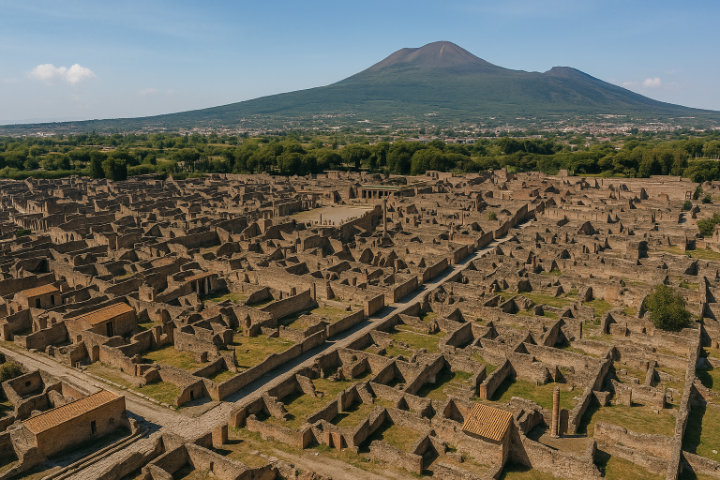
Pompeii is much more than a Roman city destroyed by Mount Vesuvius. Its streets, houses, temples and public buildings tell the story of a settlement that developed over many centuries, absorbing Greek, Etruscan, Samnite and Roman influences.
The eruption of AD 79 suddenly ended daily life in the city. At the same time, the layers of pumice and volcanic ash preserved buildings, paintings, mosaics and everyday objects that now provide an extraordinary insight into the ancient Roman world.
Explore Pompeii with a professional guide
The Origins of Pompeii
Pompeii was built on a volcanic plateau overlooking the Sarno River valley, in a strategic position between the coast and the inland areas of Campania.
The earliest settlement developed particularly between the seventh and sixth centuries BC. Its location made it possible to control roads, river traffic and commercial routes connecting the coast with the interior.
During this early phase, the city was influenced by several cultures present in Campania. Greek colonies, Etruscan communities and local Italic populations contributed to Pompeii’s religious traditions, architecture and urban development.
The first roads, defensive structures and sacred areas gradually formed the foundations of the city that visitors can partly recognise today.
Read the complete history of Pompeii on Pompeii Online
Pompeii under the Samnites
Between the fifth and fourth centuries BC, Pompeii came increasingly under the influence of the Samnites, an Italic people established across Campania and the southern Apennines.
During the Samnite period, the city expanded and became wealthier. Defensive walls were strengthened, new public buildings were constructed and existing religious areas were transformed.
Pompeii also developed close cultural and commercial connections with the Greek cities of southern Italy. These influences became particularly visible in architecture, sculpture, mosaics and wall painting.
By the second century BC, Pompeii had become a prosperous urban centre. Wealthy families built large residences with atriums, gardens, decorated reception rooms and spaces designed to display their social position.
Pompeii Becomes a Roman City
Pompeii maintained commercial and political relations with Rome for several generations.
The relationship changed during the Social War, when several Italian communities rebelled against Roman authority and demanded full political rights.
In 89 BC, Pompeii was besieged by the Roman general Lucius Cornelius Sulla. After the conflict, the city became a Roman colony in 80 BC.
The arrival of Roman settlers transformed Pompeii’s political institutions, social structure and public architecture. Latin became increasingly important, while new buildings reflected Roman customs and political power.
During the Roman period, the city constructed or expanded:
-
the Amphitheatre;
-
the Large Theatre and the Odeon;
-
public bath complexes;
-
temples and sanctuaries;
-
aqueducts and public fountains;
-
administrative and commercial buildings.
Pompeii nevertheless preserved traces of its earlier Samnite and Greek traditions. The city visible today is therefore the result of several historical phases rather than a single Roman building programme.
Daily Life in Roman Pompeii
By the first century AD, Pompeii was a busy commercial city filled with houses, shops, workshops, taverns, bakeries, temples, baths and entertainment buildings.
The Forum was the political, religious, judicial and commercial centre. It was surrounded by temples, markets and administrative buildings, as well as the Basilica, where legal proceedings and business activities took place.
Along the ancient streets, visitors can still observe:
-
raised pavements;
-
stepping stones used to cross the road;
-
public fountains;
-
shops opening directly onto the street;
-
bakeries with stone mills and ovens;
-
thermopolia where food and drinks were served;
-
workshops used for textiles and other activities;
-
political notices, advertisements and graffiti.
Pompeii was closely connected with the fertile countryside around Mount Vesuvius. Farms and villas produced wine, olive oil, fruit and other goods for local consumption and commercial export.
Houses and Social Differences
The houses of Pompeii show considerable differences in wealth and social position.
The richest families lived in large residences organised around an atrium. Rainwater entered through an opening in the roof and was collected in a basin called an impluvium.
Rooms arranged around the atrium could include bedrooms, reception areas, offices and dining rooms. Larger houses sometimes extended towards a garden surrounded by columns.
Prestigious residences could contain:
-
richly decorated reception rooms;
-
dining rooms called triclinia;
-
gardens, fountains and sculptures;
-
mythological frescoes;
-
geometric or figurative mosaics;
-
private bathing areas;
-
spaces used for commercial or political activities.
Middle- and lower-income inhabitants usually occupied smaller homes, apartments or rooms connected to shops and workshops.
Pompeii therefore preserves evidence not only of aristocratic luxury but also of merchants, craftspeople, workers and enslaved people.
Discover the houses of Pompeii
Building Techniques and Urban Development
Pompeii’s walls reveal how construction methods changed over several centuries.
Different forms of stonework, brickwork and concrete help archaeologists identify the various phases of a building. Older Samnite structures were frequently modified, enlarged or incorporated into later Roman houses.
The city was not architecturally uniform. Buildings were repaired and adapted according to changing family needs, economic conditions and social ambitions.
Construction materials and techniques also help explain how Pompeii responded to earthquakes and other structural damage.
Learn about construction techniques in Pompeii
Entertainment and Public Life
Pompeii offered several forms of public entertainment.
The Amphitheatre hosted gladiatorial games and large public spectacles. It is one of the earliest surviving Roman amphitheatres.
The Large Theatre was used for dramatic performances, while the smaller Odeon was suited to musical events, poetry and performances for more limited audiences.
Public baths were also important social spaces. They contained rooms with different temperatures, exercise areas and facilities for washing, relaxation and conversation.
Entertainment buildings and baths were not simply places of leisure. They also provided opportunities for wealthy citizens and politicians to demonstrate generosity and strengthen their public reputation.
Religion in Pompeii
Religion was present throughout Pompeian life.
The inhabitants worshipped traditional Roman gods, local deities, household spirits and cults originating in other parts of the Mediterranean.
Temples and sanctuaries were dedicated to deities including:
-
Jupiter;
-
Apollo;
-
Venus;
-
Isis;
-
Fortuna Augusta;
-
the imperial family.
Religious images were also found inside homes, shops and gardens. Small household shrines, known as lararia, were used for ceremonies connected with the family, ancestors and protective spirits.
The Temple of Isis demonstrates the popularity of Egyptian religious traditions in the Roman world, while the cult of Venus was closely connected with Pompeii’s identity as a Roman colony.
Learn more about the deities worshipped in Pompeii
The Earthquake of AD 62
A powerful earthquake struck Pompeii in AD 62, causing extensive damage to houses, temples and public buildings.
The city began a major reconstruction programme, but many buildings were still being repaired when Mount Vesuvius erupted seventeen years later.
Evidence of this reconstruction can be seen in:
-
unfinished walls;
-
stored building materials;
-
temporary workshops;
-
rooms that had not yet been redecorated;
-
public buildings still undergoing restoration.
The earthquake also changed the city’s economy. Some damaged properties were purchased, divided or converted into workshops and commercial spaces.
Pompeii in AD 79 was therefore not a perfectly completed city. It was an urban centre undergoing extensive rebuilding and social change.
The Eruption of Mount Vesuvius
In AD 79, Mount Vesuvius erupted and buried Pompeii beneath layers of pumice, lapilli and volcanic ash.
During the first phase, volcanic material fell onto streets, gardens and roofs. The increasing weight caused some buildings to collapse, trapping people who had remained inside.
Many inhabitants attempted to escape, while others took shelter in houses, shops and underground spaces.
During the later phase of the eruption, high-temperature pyroclastic currents reached the city. These fast-moving clouds of ash, gas and volcanic material killed those who had not escaped.
The exact number of people who died in Pompeii and the surrounding countryside remains unknown. The remains of more than one thousand victims have been discovered within the archaeological area.
The eruption did not preserve Pompeii perfectly. Buildings were damaged by earthquakes, falling material, collapsing roofs, heat and later human activity. Nevertheless, the volcanic deposits protected walls, mosaics, paintings and everyday objects to an exceptional degree.
Learn more about Mount Vesuvius and its volcanic history
Pompeii after the Eruption
Pompeii did not immediately disappear completely from memory.
Survivors returned to recover belongings, valuable materials and objects from accessible buildings. During later centuries, other people dug tunnels into the buried city to remove marble, stone and metal.
Some upper sections of buildings may have remained visible above the volcanic deposits. The land covering the ancient city was eventually cultivated and used for new activities.
At the end of the sixteenth century, architect Domenico Fontana constructed a canal across the Civita hill. The work passed through parts of the buried city and exposed walls, objects and inscriptions, although the ruins were not yet systematically investigated.
The Rediscovery of Pompeii
Systematic exploration began in 1748 during the reign of Charles III of Bourbon.
The earliest excavators initially believed that they were investigating part of ancient Stabiae. An inscription discovered in 1763 helped confirm that the buried city was Pompeii.
Early excavations concentrated mainly on recovering:
-
statues;
-
frescoes;
-
mosaics;
-
precious objects;
-
architectural decorations.
Many discoveries were transferred to the royal collections that later became part of the National Archaeological Museum of Naples.
The early methods were often destructive. Walls were damaged, paintings were removed and some areas were reburied after valuable objects had been recovered.
Over time, archaeology became more systematic. Excavators began recording houses, streets and the organisation of the city rather than searching only for individual works of art.
Giuseppe Fiorelli and the Plaster Casts
Giuseppe Fiorelli directed the excavations during the nineteenth century and introduced important new methods for recording and presenting Pompeii.
He organised the city into the system of regiones, insulae and entrance numbers that is still used to identify buildings.
Fiorelli is also associated with the technique used to create plaster casts of victims.
When a body decomposed inside compacted volcanic material, it sometimes left an empty cavity containing skeletal remains. Liquid plaster was poured into some of these spaces. Once the plaster had hardened and the surrounding ash was removed, the cast reproduced the position and external form of the victim.
The casts transformed the public understanding of the eruption by presenting the victims as individuals rather than as anonymous archaeological remains.
Pompeii in the Twentieth Century
Excavations continued during the twentieth century, particularly under archaeologist Amedeo Maiuri.
Large areas along Via dell’Abbondanza were uncovered, while archaeological research increasingly considered houses, workshops, shops and evidence of everyday life.
Pompeii also suffered serious damage during the Second World War. Allied bombing in 1943 struck several parts of the archaeological area.
Later restoration campaigns repaired damaged buildings and introduced new conservation methods. However, the exceptional size of Pompeii has always made its protection particularly difficult.
Rain, vegetation, earthquakes, tourism and the natural deterioration of ancient materials continue to create conservation challenges.
Pompeii Today
Pompeii is not a completed archaeological excavation.
Research, conservation and restoration continue, while new investigations still reveal rooms, frescoes, objects and information about the people who lived in the city.
The ancient settlement covers approximately 66 hectares, of which about two-thirds have been excavated.
Pompeii, Herculaneum and the villas of Torre Annunziata were added to the UNESCO World Heritage List in 1997.
Modern research combines:
-
traditional archaeological excavation;
-
scientific analysis;
-
digital mapping;
-
photography and three-dimensional documentation;
-
geophysical surveys;
-
studies of human, animal and plant remains.
Pompeii remains both a major visitor destination and an active archaeological research site.
Read news and recent discoveries from Pompeii
What to See to Understand Pompeii’s History
A visit becomes easier to understand when each building is considered as part of a living city.
The Forum
The political, commercial and religious centre of Pompeii, surrounded by temples, markets and administrative buildings.
The Basilica
A large public building used for legal proceedings, commercial exchanges and meetings.
The Theatres
The Large Theatre and Odeon illustrate the importance of drama, music and public entertainment.
The Amphitheatre
One of the earliest surviving Roman amphitheatres, used for gladiatorial spectacles and major public events.
The Baths
The public bathing complexes reveal Roman engineering, hygiene, social customs and attitudes towards leisure.
The Houses
Residences such as the House of the Vettii demonstrate domestic architecture, artistic decoration and social display.
The Shops and Workshops
Bakeries, thermopolia, laundries and other workshops illustrate the economic life of the city.
The Antiquarium
The museum near Porta Marina presents archaeological objects and information about Pompeii from its origins to the eruption.
Download the Pompeii map and plan your route
Discover the official guide to the Archaeological Park of Pompeii
Discovering Pompeii with a Guide
Many buildings in Pompeii survive only to wall height, and their original function is not always immediately recognisable.
A professional guide can explain:
-
how the city changed before and after Roman colonisation;
-
the function of the Forum and public buildings;
-
the differences between wealthy houses and modest homes;
-
Roman religious practices;
-
shops, workshops and food production;
-
the earthquake and eruption;
-
the rediscovery of the city and the creation of the casts.
Visitors can choose a tour beginning directly at the archaeological park or an organised experience with transport from Naples or Rome.
Pompeii guided group tour with admission included
Pompeii guided tour with transport from Naples
Compare all Pompeii guided tours
Plan Your Visit
Before travelling, consult:
Pompeii should not be understood simply as a city destroyed by a volcano. It was a community that developed, changed and rebuilt itself over many centuries before the eruption brought its history to a sudden end.